
At a glance: A club pickleball night needs a hall with badminton lines, a portable net or two, a small loan set of paddles and a tub of balls – a modest one-off spend that regularly becomes the best-attended session on the timetable. Here's the full shopping list, the session formats that work, and why members keep coming back.
Step one: the equipment list
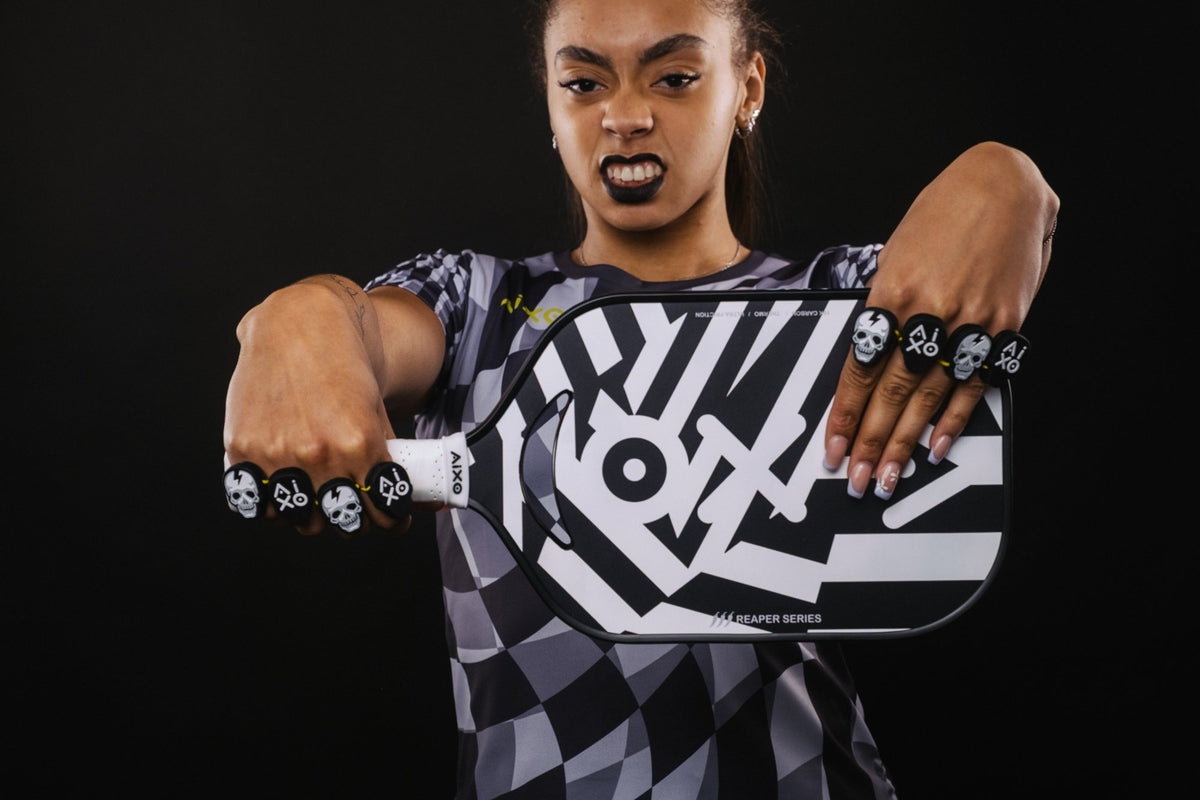
Per court, you need: a portable pickleball net (or a badminton net dropped to 36in at the posts), floor tape for the kitchen and centre lines, four paddles and a handful of balls – indoor balls (softer, larger holes) for sports halls. For paddles, buy a loan set of six to eight AIXO Ghost paddles (T700 carbon, 16mm, ~£40): forgiving enough for absolute beginners, good enough that nobody blames the kit. Add a pack of AIXO overgrips for mid-season handle refreshes, and as regulars emerge, point them at the USAPA-approved Scorpion for their own paddle. We build exactly this as a club starter bundle – ask us to quote for your court count.
Step two: set up the hall
Every badminton court in your hall is a pickleball court in waiting – the 20ft x 44ft footprint is identical. Lower or swap the net, tape kitchen lines 7ft out from the net on both sides, add a centre line, and you're done in about ten minutes per court. A three-court badminton hall becomes a three-court pickleball night with no structural changes whatsoever.
Step three: pick a session format
Formats that work, in rising order of competitiveness: open play (winners stay on, doubles rotate in – ideal for tasters); round-robin mixers (shuffled partners each round, so newcomers meet everyone); ladder night (challenge matches up and down a board – the retention engine); and internal league once you have sixteen-plus regulars. Doubles-first every time: four players per court doubles your capacity and halves the intimidation factor.
Why members love it (and committees should)
The underarm serve and slow ball mean a first-timer rallies within minutes, so taster nights convert. The small court keeps veterans competitive when their knees have retired from other sports. Mixed-age, mixed-ability doubles genuinely works, which makes it the most sociable session a club can run – and it monetises daytime and off-peak hours nothing else fills. Clubs that lean in properly kit their squads in matching AIXO men's and women's teamwear – we handle club orders and customisation.
FAQ
How many players per court should we plan for?
Six to eight per court per hour keeps everyone moving in a rotation format – doubles plus a waiting pair or two.
Do we need a coach to launch?
No – one confident organiser with the three core rules is plenty for social nights. Bring in coaching once a competitive group forms.
What should we charge?
Most clubs price it like a badminton session – a few pounds a head – and find the loan kit pays for itself within weeks.